Developing an Ethics Statement as a Tarot Reader
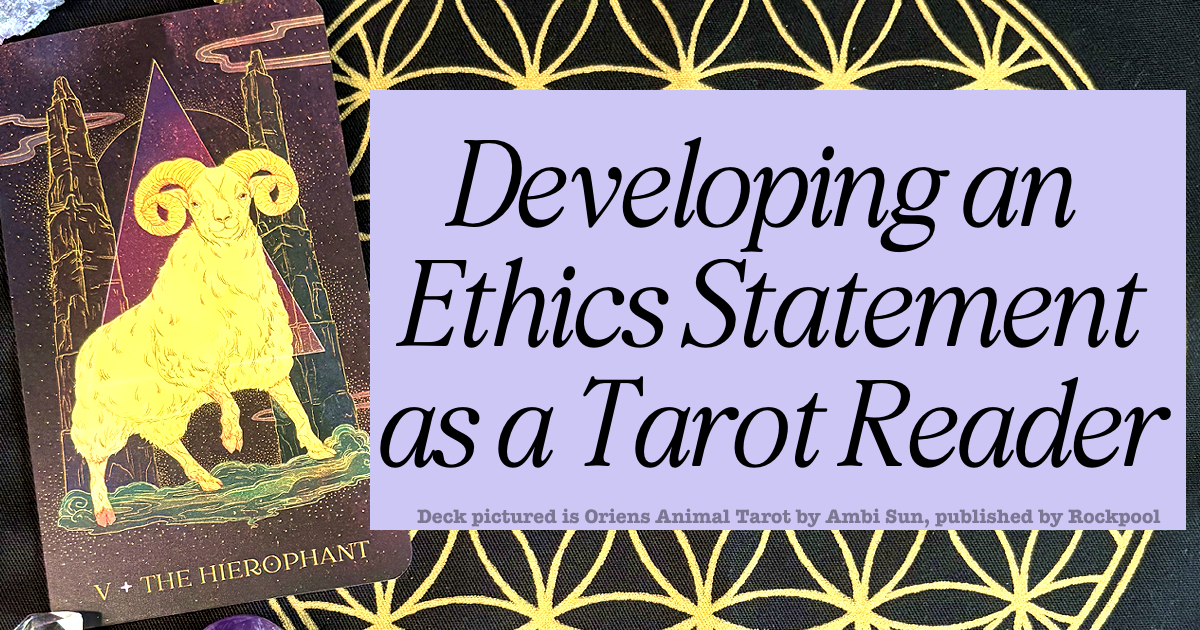
Deck pictured is Oriens Animal Tarot by Ambi Sun, published by Rockpool. Card art copyrighted to Ambi Sun
Image description: The Hierophant depicts a ram between two towers with a cosmic background, the card lays on a black and gold flower of life tarot mat
An ethics statement provides a framework for readers to reflect on themselves, their values, their professional practices, and what they offer to their clients. Readers of any level can develop an ethics statement, whether you are reading professionally, reading for friends and family, or just starting your journey. As you read this post, consider what portions resonate for you personally. They are good clues for what might go on your own personal ethics statement.
Why craft an ethics statement?
An ethics statement provides clients with a sense of who you are and what you stand for. It can help clients feel confident that they have found the right reader to support them, and it can help readers align themselves with clients that are a good fit for their energy.
An ethics statement can act as a guiding light in times of uncertainty. Unexpected situations can arise without any warning. For example, you might be gaining a reputation for insightful relationship readings. What happens when a repeat client comes to you suspecting that a partner of theirs is cheating? What if that partner is a client of yours too? Knowing your personal boundaries regarding third party readings, understanding the importance of client confidentiality, and reflecting on what questions you can be objective about, are all important areas of ethical exploration. Thinking about these areas before a situation arises can help us be prepared. An ethics statement can also be a document you turn to if you choose to decline a reading.
An ethics statement is a focal point we can return to whenever we want to center ourselves. It can help you evaluate whether you are living in alignment with your values. As you continue progressing in your craft, your ethics may change. Your ethics statement can be a living document that grows with you. Periodically checking in with your statement can be a practice that helps you see your growth over time.
What should I include in my ethics statement?
You may choose to include statements that reflect your personal values, you may include some of your boundaries, and if you’re offering your services for payment you may choose to include some policies. Some professional readers may publish their policies in a separate document.
You may choose to explicitly state what types of readings or services you do not provide. For instance, many readers do not read on legal questions, health questions, or major investment questions. Stating this up front can save time for both the client and the reader. Before you start reading professionally, research your local laws regarding reading tarot to understand what questions you may want to avoid and what disclaimers you may want to use.
Outside of health and legal questions, there may be other topics that you personally don’t feel comfortable reading on. You may feel that certain questions are beyond your current abilities. For instance, you may feel that certain questions could be better answered by a practicing medium if you are not a medium. Some people may feel they are not equipped to read for certain topics that are areas of personal struggle for them. If you’re in a place where you cannot be objective, you may choose to decline certain topics while you are working through that area in your own life. This doesn’t mean you have to avoid those topics forever. This kind of honest evaluation is a conscientious choice that honors the responsibility that comes with reading for others.
You may include your perspective of what divination is or isn’t. If you personally don’t like to use tarot for future prediction, you may choose to state that, so clients know not to expect it. If you feel that divination reflects current energies that can shift based on our actions, you might include statements about the power of free will.
You might include statements that reflect what your services provide to a client. This could include information about your reading style and tone. As a tarot reader who blends psychic messages and channeled information in my readings, I want clients to know they may receive this kind of information in their experience. I don’t want a client to be surprised by channeled information if they have never had a tarot reading before.
Some readers do not guarantee that a client will feel more certain, guided, or confident after a reading. Readings can bring up unexpected and challenging feelings at times, especially if it is an emotionally charged topic. Having statements regarding what is or is not guaranteed for an outcome can help set the tone for what to expect from a reading.
More ideas for getting started with your ethics statement
Hopefully this has already given you some ideas about what may or may not go on your own ethics statement, but here are more ideas that you can explore.
Consider writing down a list of values that are important to you personally. You don’t have to include all of these in your statement, and some of them may not apply to reading tarot, this is a starting point to get your ideas flowing.
Your list could include respect, compassion, inclusivity, honesty, non-judgement, self-improvement, self-awareness, and courage. There are many, many different values that could be on your list. Next, write how each value might show up as a tarot reader. Let’s take respect as an example. Some statements for respect could include:
-I will hold respect for my clients and their unique paths in life.
-I will keep readings confidential out of respect for my clients’ privacy.
-I will respect myself and my time by not refunding for no-show appointments.
Write as many of these statements as you feel you need to, then choose which ones you want to include.
Whether you share your ethics statement with others is a personal decision. You may write an ethics statement purely for yourself and share it with no one. You may have one version that you publish and additional values that you keep to yourself. I have some personal boundaries that I practice but don’t feel the need to publish in my reader ethics statement. For example, I personally do not read for others when my energy level is too low. I want to provide the best service possible to my clients, and that means reading when I am feeling my best, not when I am exhausted. This is why I do not promise 24-hour timeframes for readings unless agreed upon in advance.
You may consider reading the ethics statements of other readers who you respect. Their statements may give you some ideas for areas you didn’t think of but want to cover. However, do not copy another reader’s ethics statement or use their language verbatim. Not only is copying verbatim plagiarizing their words, but your ethics statement should reflect your personal values, and not just copy someone else’s.
If you are looking for support and guidance on your tarot journey, including coaching as you develop your own ethics statement, I offer tarot mentorship services to developing readers. It is my honor and joy to support readers as they develop in their own unique path. Read more about tarot mentorship here or if you’re ready to chat, please reach out and contact me.I also offer tarot readings on a wide variety of topics.
And if you’d like to review my own personal ethics statement, it is available here.
Want to subscribe to the blog? Enter your email below and I’ll add you to my newsletter. I reach once a month with links to the blogs I’ve posted along with special offers. Unsubscribe any time.
Sources:
*Disclosure: I am an affiliate of Bookshop.org. The links below are affiliate links. I receive a portion of the purchase of any book through the link. It comes at no additional cost to you. Bookshop.org supports independent bookstores.
Reed, T. (2020). Tarot: No questions asked: Mastering the art of intuitive reading. Weiser Books. Available from Bookshop.org here: https://bookshop.org/a/121930/9781578637133
Oriens Animal Tarot by Ambi Sun can be purchased from Bookshop.org here: https://bookshop.org/a/121930/9781925946826